
Five and a half centuries ago, the monks who produced books in scriptoria using only an easel, paper, quill pen, ink, and their hands were likely amazed and daunted by then relatively complicated technology of Gutenberg’s moveable-type printing press and its conceptually new process of not producing pages word-by-word linearly but using a mechanical platen to imprint each side of a paper sheet that could contained multiple pages at once. I’ve noticed that today’s publishers and broadcasters of Mass Media suffer similar confusion about how to use the technologies of Individuated Media. Indeed, their confusion is probably worse because the main companies nowadays that are using such technologies are Facebook, Vkontakte, X (formerly Twitter), SinaWeibo, Spotify, etc., whose Individuated Media technologies are housed in plantations of data centers that consume megawatts of electricity.
Moreover, a hidebound tent of the Mass Media industries long has been to emulate whatever their sector’s biggest Mass Media companies do. I’ve indeed heard some executives in the newspaper sector say that they won’t attempt to experiment with ‘personalization’ (by the way, a misnomer) of their newspaper’s contents until the major national daily in their country does. They forget that Gutenberg worked neither for a major publisher nor a monastery employing dozens or hundreds of monks in scriptoria. Printing press themselves were originally the product of an innovative entrepreneur starting on a very small scale. Whenever I hear a Mass Media executive tell me that he hesitates doing something innovative until others in his industry sector begin doing the same, I instantly know that I’m dealing with someone who is a leader only according to his business card. He is just another pothole on the path to industrial success.
Sixty years ago, my father gave me permission to open a locked door leading steeply upstairs to third floor of my family’s then centuries-old daily newspaper (circulation: 10,000 copies per day) building. What I discovered there was an attic containing what seemed to be a museum of printing technologies from the late-19th and early 20th centuries. That was the day when I realized I was part of a Mass Media sector whose original success didn’t depend upon if its new technology was invented in a Pentagon-sized data center today or Gutenberg’s single-room storefront in 1454 Strasbourg. Revolutionary technologies seep up probably as often as down.
Here are the six steps I would take to give that daily small newspaper (which I sold in 2017) the capabilities to individuate:
- Light the Spark
Don’t daunt yourself; you don’t need a data center to do this. Remember that Moore’s Law, its corollaries, and their interactions predict that every 9 to 36 months the costs of the technologies halve and the capacities and powers of the technologies double. Understand that, for example, your smartphone already has the capabilities and power of ASCI Red, the $55 million supercomputer which held the title of the world’s fastest in 1999.
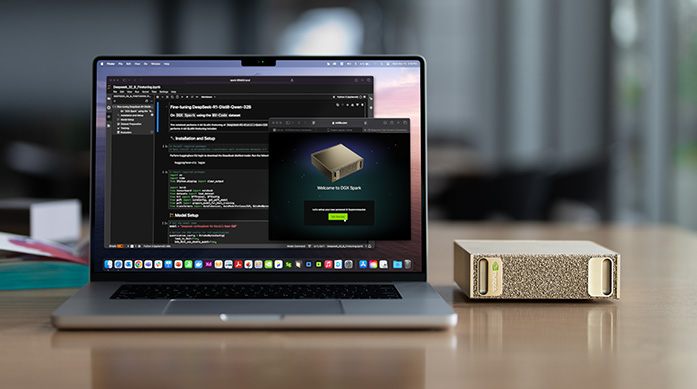
Start by purchasing a device like NVIDIA’s DGX Spark Artificial Intelligence desktop supercomputer. It’s available from Amazon for $4,700 (yes $4,700, not $4.7 million). Its 1-petaflop NVIDIA Blackwell processor and 128 gigabytes of RAM are equivalent in power to IBM’s $33 million Roadrunner supercomputer of 2008. Besides price, the differences between the Roadrunner and the Spark are the former used 296 racks of equipment sitting on 6,000 square feet (56 sq. m) of floor space, weighed 500,000 lbs. (22,700 kg), consumed 2.5 megawatts of electricity per hour, compared to the 2 lbs (1 kg) Spark, which is the size of a hardcover book and uses 240 watts of electricity per house. Its 1-petaflop Blackwell superchip can process up to 200 billion (yes, ‘b’ as in billion) local parameters, which is computerese meaning that if there are ten million people living in your market area, the Spark can process up 200,000 items of profile information about each of them. (Do you see the progress of Moore’s Law between 2008 and today?) And if you’d like to give your system redundancy, Amazon sells a connected pair of Sparks for $9,500. Be sure to always use a Universal Power Supply battery backup when using one or both.
Now load into the Spark a Small Language Model (SLM) software (also known as TinyML software) which is available free online. I’d suggest either Mistral 7B or Llama-3-8B. If there is a competent IT person on your staff, he will likely be able to install it (if you need to hire someone else to do that, their installation fee shouldn’t be more than perhaps $700 to $1,000).
The first use of this AI system should be to load into it your small daily newspaper’s entire archive. If you had already digitized your archive, excellent! But if the archive is instead on microfiche, you’ll unfortunately need to purchase a dedicated microfiche scanner (such as the ST ViewScan 4 which cost $6,500 to $8,000 new or typically $4,800 to $5,000 used) because Microfiche is an obsolete 120-year-old technology never designed for digitization. However, if (like the newspaper I owned) the archive is in the even older form of newspaper stories clipped and glued onto typewriter pages, just load pages into a device such as the $550 Epson FastPhoto FF-680W which can scan 60 such pages per minute. The SLM software will read, analyze, and catalog every story, document, photos, diagram, image and spreadsheet input. Once the entire archive is input, your newspaper will immediately have a system that can virtually instantly analyze the history of your community and provide thorough research and context for current stories. A dozen Library Science Ph.D.s couldn’t do the same research as quickly or likely as thoroughly.
Keep this up to date by manually adding all new stories that the newspaper publishes, plus supporting documents, reporters’ notes, local police blotters, town zoning and construction permit application and decision, local government and school board minutes, births and obituaries, local schools’ sport box scores, and anything else that might back or suggest new stories. Analyzed by SLM software, this wealth of current and historical data also can discover (i.e., data journalism) unknown or unrealized links that lead to more new stories.
I’d also advise inputting into the Spark all supplementary and syndicated sources received by the newspaper. (That would normally include the Associated Press’s fine DataStream feed if it weren’t that the AP this month announced that it will soon stop serving the newspaper industries.)
By the way, having an instantly-searchable electronic archive can also provide the newspaper with an additional revenue stream if you allow consumers to access it for a minor subscription or usage fee. Such a system can pay thus for itself.
- Agency
Great start, but why input manually? Your next step should be to start creating and utilizing a squadron of newsroom ‘micro agents’ that eliminate as much of that work as possible and supplement your newsroom staff. This is known as Agentic Artificial Intelligence (AAI). Can you persuade police, schools, hospitals, undertakers, and government officials to email or otherwise routinely send you the types of information above that I suggested inputting? (Give your Spark its own email address and ask the device to verify from Internet Protocol. address the sender’s identity before processing the contents to avoid spoofing or fraudulent inputs.) If you can’t persuade those folks to do so, ask Spark to create programs (e.g. agents) that routinely search for that information on the websites of those organizations. Have these programs also alerting the appropriate journalism if certain things occur (e.g. shootings, verdicts, etc.) Such agents greatly increases your newsroom’s informational power and can greatly reduce your journalists’ daily chores, letting them concentrate on more important tasks.
- Neighborhooding
However, you haven’t yet begun to provide individuated information to the people of your community. It’s time to begin doing so.
Would the people who live in specific neighborhoods, tracts, developments, or regions of the community like to receive news and other information that increasingly focuses on there? Such news and information wouldn’t appear in the printed edition because there isn’t sufficient space to justify publishing it to the entire newspaper’s readership. If so, ask Spark to create an emailed newsletter for each neighborhood, etc. To subscribe, consumers would merely have to provide their email and postal addresses, plus perhaps select from a checklist what types of information they want. Spark can then email each subscriber a daily or otherwise periodical newsletter containing all births, deaths, crimes, real estate transactions, building or construction permits, school lunch menus, or other items and stories specific to that subscriber’s own neighborhood. This also allows Spark to begin building a database of those subscribers’ names, addresses, and interests.
Whether to offer such a service free or for a small subscription fee is up to the newspaper. The former is much more likely to build the database much more quickly, which would be my suggestion.
- Requests
Once you’ve created such agency and database, artificial intelligence allows you to expand individuation. Here are three of possibly dozens or hundreds of examples:
- A retiree might be very interested in property taxes. He can obviously read any stories published in your newspaper about that topic, but might he also like to receive the minutes (or even official or reporter’s video) of the government meetings about that subject? Spark can provide that.
- A parent has a child playing for a municipal school basketball team. Maybe the printed newspaper regularly publishes stories about the team’s games. But if not, such as with elementary or junior high schools, would that parent like to receive game box scores and other information that might not have reached print?
- Care to know the history of your address? Who has lived there, what occurred? Or anything currently pertaining to the streets or water, natural gas, or electric lines supplying it?
I think these services, deeply local and relevant, certainly become for which the newspaper can charge some subscription fee.
- Hypercustom
A Spark (or similar equipment) loaded with SLM or LLM (Large Language Model) software can also create services in which the nature, tone, and format of the service can be individuated. This ‘hyper-customization’ can take generally three or more forms:
- Focus: the newsletter that the parent of a student who plays on a school sports team can receive game stories that focus on that student (e.g. ‘Despite strong work by shooting guard Billy Jone, the Eagleville Eagles lost to the Putnam Falcons 54 to 62’) rather than receive the otherwise generic story about that game.
- Format: because the Spark is capable of translation, a recent immigrant can receive the stories in his native languages rather than in the English-language version.
- Tone: a subscriber can choose to receive the stories in short summaries; someone with a Ph.D. can choose the stories lengthier and featuring deep analysis; and an earlier teenager can receive the stories in comic strip style illustrations.
I should by now interject four important notes about using individuation:
First, the individuation offered need not be total. The concept is neither a binary nor Manichean choice. There is a spectrum between total customization and none. Any editor who wants to ensure that everyone in his community becomes informed that their town has been sold to Albania can program the Spark to ensure sending such bulletin-level stories to everyone. The degree of individuation these services offer is a decision by the content provider.
Second, producing individuated, rather than only general-interest, media services will lead to some consumers into informational ‘bubbles’ or ‘echo chambers’ due to their seeking and selecting only information which reinforces their preexisting beliefs and prejudices. For examples, an older man might select to receive only information that he thinks will reinforce his political beliefs. Or a teenage girl might select to receive news only about her favorite pop singer. This effect rather too widely already occurs in social media. Because media technologies have advanced to the point of offering individuation, this becomes almost ineluctable because it is a flaw in human behavior. I’ve been involved in faculty discussions in which the traditionalists of Mass Media rail that it gives reason to prohibit individuation. (One journalism professor claimed that if this anecdotal older man or a teenage girl desire to be informed only about what they insularly want, then they should instead be forced to receive contrary information so to protect democracy. I declined to remind the professor, a fan of democracy that in one the man and girl should have the right not to be thus forced.) Do citizens in democracies have the right to not be informed of something? There are very many stories that consumers don’t received via In the Mass Media, either because there isn’t room in printed pages of periodical or time within a half-hour, hour-long, or 24-hour broadcast to include every story. It is
lamentable that some consumers will utilize individuation to isolate themselves, but that a fair price to pay for others consumers to receive a more relevant and more engaging selections of contents than they’d ever had before?
Third, there is no theoretical reason why individuation cannot be offered in in print. During an Individuated Media conference that I attended during the opening years of this century, a newspaper publisher claimed that it was impossible to print a mass-individuated product. Other newspaper publishers nodded their heads. Yet he and those other publishers have been receiving mass-individuated printed contents for decades. Each statement they receive monthly from a bank, credit cards, utilities, etc., is mass individuated. The letterhead of the statement is the same received by all account holders of that company, but the individual account data and balances printed on that statement are unique to that person. Each company uses computer-connected digital printers connected to individuate statements. Unlike the analog lithographic printing presses used by newspapers and magazines, digital printers are basically giant ink jet printers that print at high speeds. (At that conference, the publishers also claimed that it would be impossible for newspaper delivery personnel to deliver individuated editions in print to each specific individual. Yet I know that postmen somehow do the equivalent every day!) Nonetheless, I think the era of widespread print is ending and that almost all media information is ready dissemination online rather than from presses of any type.
Fourth, as the numbers of consumers receiving individuated newsletters increases and likewise the degree of customization for each, the media organization’s individuation infrastructure will need to be strengthened and increased. A miniaturized supercomputer such as Spark will work for small media organizations, but it must use LLM software rather than that for SLMs. The main bottleneck for larger scalability will be the media organization’s existing server connecting to the Internet. To process tens or hundreds of thousands or millions of individuated newsletters or archival requests, a Real-Time Data Streaming server (such as using Apache Kafka) will be needed.
The technology of Retrieval-Augmented Generation (RAG), which relies upon multiple rather than a single database, will also help. And for very large numbers of consumers, the Spark ultimately will have to be replaced by use of Distributed Cloud Architecture Edge Computing to avoid centralized bottlenecks and delays.
- Commercial
Although I’ve worked as a journalist, an executive at UPI, Reuters, and News Corp., and have consulted mainly to news organizations, I’d owned and published a daily newspaper long enough to know that a significant fraction of consumers read newspapers mainly for the advertisements than for the news. More than 40 years ago, before the rise of the Internet, it was between 35 and 40 percent of readers! Nowadays, after newspaper had lost classified advertising to CraigsList, Monster.com, and other online services and now that most advertisers have their own websites, the percentage is much smaller.
Nevertheless, recent surveys show that 61 percent of people trust advertisements in newspapers more than they trust ads online, plus that printed ads receive a 9 percent response rate compared to online ads (including social media). Such data infers that newspapers might still be the most media in which to place advertisements. Contrary data shows that newspapers’ websites aren’t frequently visited by their average users. Nevertheless, recent surveys show that using ‘personalized’ direct postal mail boosts response rates by 88 percent, outperforming most other online advertising methods. So, given that roller coaster of survey data, is it possible to use individuation technologies to leverage trusted advertising role of newspapers to supplement and exceed newspapers’ less than stellar revenues from website banners ads?
Once a publications newsletter subscriber ranks grow, I suggest experimenting with provision of product and service information in those individuated newsletters. See if there is willingness and technical capacity among the community’s retailers for that. Can auto dealers provide the newspaper’s AI with information about their inventories of new and used cars for sale? Or can an AI’s ‘agents’ obtain that information by scraping it from the dealers’ websites. And from other types of businesses, the inventory of houses for sale or rent, apartments, etc. Would any local consumers want to be alerted if a seller drops the prices to what a consumer considers an agreeable price? The local newspaper used to be the central hub of information about products and services in its community for information. Can that situation return? It’s worth an experiment to find out.
And when I mention product and service information, I’m not advocating that advertising be placed adjacent to the news in these newsletters but listed as news itself (perhaps placed below all the other items so to keep some segregation as ‘retail news’).
I believe that the six steps I’ve described show there needn’t be any ‘Digital Moat’ preventing small companies from implementing and utilizing individuation technologies.
The Editor’s New Role
Unlike with the selection of stories that a traditionally printed newspaper might publish each day, no human editor can possibly examine and authorize a hundred, thousand, or million individuated newsletters being published simultaneously. Human ‘gatekeepers’ are being replaced by algorithmic ones. The time may also arrive when the best news organization isn’t the one with the best reporters on staff but the one with the best generative algorithms, including those for pre-synthesis verification. In Mass Media newsrooms, the editor decides what is ‘relevant’ for the whole community; in the Individuated Media newsroom, the algorithms decide what is ‘relevant’ for the community’s individuals. In both of those cases, the editor’s role is to set the guardrails. In the Individuated case, she does this not by reading each or most stories prior to publication, but by ensuring the guardrails of the algorithms programming prior and refining those ever afterwards. In Mass Media there always are the dangers of inaccuracies or fabrications; in Individuated Media the dangers are of faulting programming, plus Artificial Intelligence ‘hallucinations’ in which inaccuracies appear. The Editor also is the algorithmic auditor ensuring that the algorithm is transparent and doesn’t become too biased toward consumer ‘engagement’ (i.e, addiction to hyperclicks) rather than to over informing consumers (i.e., civic duty).
Wherewith Academe
In my recent 14 years teaching postgraduate the New Media Business in a Media Management curriculum and as a presenter at the World Association of Media Economics and Management and the International Media Management Academics Association, I’ve met many bright professors (one of whom notably has earned Ph.D.s in both Rocket Science and Media Management, hence a ‘Dr. Dr.’). Unlike the academic fields of Physics, Medicine, and Law, however, I’ve come to discover that professors of media or journalism tend to ‘follow’ rather than lead their professions. That’s a pity during epochal changes in the media environment, when media industries, companies, and practitioners are in dire need of research and leadership how to overcome the challenges of these changes.
Indeed, much of what I’ve written about the rise of Individuated Media, the phenomenally popular and financial successes of the companies that provide it; and how those successes have come at the expenses of the Mass Media industries, are readily observable and documented. Not all the theories, doctrines, business models, products, services, and practices of Mass Media will survive this transition. I’ve mentioned some of the business models and contents production, and editorial practices that will change. Many of those are nevertheless still being taught as media industry gospels in schools of media and journalism. To say that media academe needs to rise to the occasion, provide leadership, and abandon, reformulate, or research and devise some Mass Media theories, doctrines, business models, and practices, is an understatement.
Encomia
Closing this subject, I give my compliments, as always to my mentors Dr. Ben Compaine of Northeastern University and co-editor emeritus of the Journal of Media Economics, for first interesting me in Media Management as more than just a business; Dr. Robert Picard, formerly of Oxford University, Univ. of Canberra, Tsinghua Univ. in Beijing, Univ. of Tampere, and founder of the World Media Economics and Management Conferences, for mentoring me; and Dr. Gregory Lowe of Northwestern University in Qatar and former president of the International Media Management Academics Association for guiding me. And to Steve Masiclat, former director of the graduate program in New Media Management at Syracuse University, for seeking me out when I was co-chairing and co-moderating the Beyond the Printed Word in Vienna during 2006 and suggesting that I teach.